International Project
to Study Effects from Bioaerosols on Layer-clouds and Climate with AI
Project leader: Dr V. Phillips, INES, University of Lund, Lund, Sweden
Unfunded collaborator: S. Burrows, Pacific Northwest National Laboratory (PNNL), USA
Unfunded collaborator: M. Ohlsson, Centre for Environmental and Climate Science, Lund University, Lund, Sweden
Overview
A project entitled “Primary bio-aerosols, layer-clouds and climate simulated with deep learning AI” led by Lund University was funded in 2021 by the Swedish Research Council for Sustainable Development (‘FORMAS’; award number 2021-01463). The project will continue until 2027 or 2028.
Institutions in USA and Sweden are involved in the collaboration:
· Atmospheric Sciences & Global Change, Pacific Northwest National Laboratory, in USA;
· Centre for Environmental and Climate Science, Lund University, in Sweden;
· Department of Physical Geography and Ecosystem Science, Lund University, in Sweden.
Primary biological aerosol particles (PBAPs) are ubiquitous in the global troposphere and are emitted by land vegetation. Concentrations can be as high as a few per cm3 or even higher. Five broad types of bioaerosol are:
· Bacterial
· Fungal
· Pollen
· Algal
· Plant/animal detritus
Some images of these collected in a past mission to the Amazon (Patade et al. 2021) are shown below.
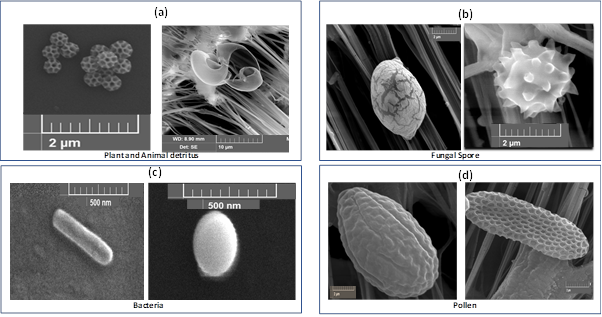
Scanning electron microscopy (SEM) images of bioaerosols sampled from the ATTO tower near Manaus in Brazil for (a) plant/animal detritus; (b) fungal particles, (c) bacterial particles and (d) pollen. From Patade et al. (2021).
Most biological aerosols can initiate cloud-droplets by acting as “cloud condensation nuclei” (CCN) at supersaturated humidities above water saturation. A few can initiate ice crystals by acting as “ice nucleus particles” (INPs) at subzero temperatures and humidities above ice saturation. A distinctive feature of PBAP-INPs is that their frequent ability to nucleate ice at warmer subzero temperatures than other types of INP.
In the troposphere above the rainforest in the Amazon of Brazil, most of all INPs active at temperatures warmer than about -25 degC have been seen to be biological. PBAPs may also be abundant in other regions of vegetated landmass.
It has long been hypothesized that these bioaerosol particles, by initiating cloud-particles in this way, can alter cloud properties and precipitation. Generally, the propensity of clouds to produce precipitation is influential for the climate because precipitation is the chief means for removal of water substance from the atmosphere. Any change in precipitation efficiency of clouds can alter their cover, influencing the Earth’s radiation budget (e.g. through altered reflection of solar radiation to space) and hence, the climate.
From a biological or ecological perspective, any appreciable impact from bioaerosol particles on certain types of clouds can make such clouds part of their natural biome, potentially aiding their dispersal spatially.
Mixed-phase layer-clouds can exist entirely at such warm zubzero temperatures where biological ice nucleation can prevail. They can generate their precipitation either by the ice phase or by coalescence of cloud-droplets, as quantified in another past project. The ice crystal process of precipitation production involves INPs initiating crystals that then grow to become snow, which may either rime to form graupel or may melt as rain. Any precipitation removes condensate from the cloud, determining the cloud lifetime and microphysical properties. Thus, there is reason to expect that mixed-phase clouds can be sensitive in their properties to loadings of bioaerosols in the environment.
In a past project, we developed a formulation for use in cloud models for biological ice nucleation by each of the five broad types of PBAP-INP noted above (Patade et al. 2021). We then applied it in a cloud model to quantify bioaerosol effects on deep convective cloud systems over USA. Little effect on their cloud properties was found.
Consequently, the current project is oriented towards a different cloud-type, namely mixed-phase stratiform cloud. The aim of the current project is to quantify how the radiative and microphysical properties and extent of such layer-clouds over mountains in USA can respond to fluctuations in loadings of these five types of PBAPs.
The approach will be first to boost the realism of the model. A central dilemma is that biological ice initiation is only one of several pathways of ice initiation in clouds and they all need to be adequately treated in any modeling study. The most prolific of these is poorly constrained, being uncertain due to a lack of lab observations, namely fragmentation in ice-ice collisions. Thus, first we will perform field observations of breakup in graupel-snow collisions.
Next, we will incorporate the observations in our cloud model and apply it to simulate an observed case of layer-clouds, with validation and analysis of simulations to explore scientific hypotheses. Finally, we may extend the results to the global scale by including biological ice nucleation in a new AI-scheme being developed in another recent project.
In summary, the project seeks to evaluate the role of biological ice nucleation for a cloud-type expected to be susceptible to influence, namely orographic mixed-phase layer-cloud.
Field/lab experiment
For a trip to the Jungfraujoch observatory in Switzerland in March 2024, a chamber (a portable laboratory) constructed by Gautam et al. (2024) in a previous project was deployed to characterize breakup in graupel-snow collisions. It consists of a fixed array of ice spheres (mimicking graupel aloft) inside a chamber partially exposed to falling snow outdoors. Naturally falling snowflakes impact on the ice spheres and the fragments of ice are recorded by video camera. The imagery was later analysed. The masses of incident snowflakes were inferred from the imagery using a mass-size relation measured in situ during the sampling. Two earlier trips to the observing stations in Vindeln in northern Sweden and Jungfraujoch, which both had laboratories, had encountered no snow.
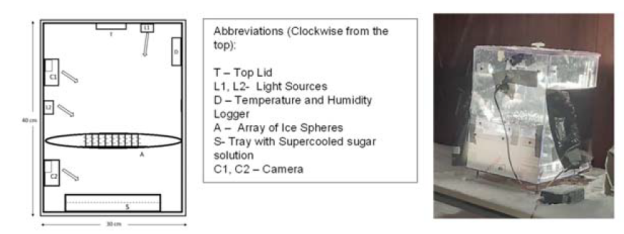
(a) Plan of 2D vertical section of the chamber for measuring breakup in collisions between naturally falling snowflakes and graupel/hail particles, represented by an array of fixed ice spheres (left panel). Also (b) a photo of it is shown (right panel). From Gautam et al. (2023).
The trip to Switzerland yielded measurements of
fragmentation that extend those by Gautam
et al. (2024) in February 2022 to include unexplored crystal habits of the
falling snow. In contrast with the study
by Gautam et al., the Swiss trip studied snow falling from cloud located at colder
temperatures, mostly above the dendritic region ( to
to  degC). The cloud-base was at about
  degC.
degC.
A paper is in review at Journal of the Atmospheric Sciences describing a revised formulation of graupel-snow fragmentation for use in atmospheric models to treat secondary ice initiation (Paul et al. 2026). The scheme will be applied in the present project in our cloud model, enabling the role in nature of primary ice initiation by bioaerosols to be evaluated more accurately.
Cloud modelling
Our Aerosol-Cloud model (AC) predicts the total number and mass of hydrometeors in five microphysical species, namely cloud-liquid, cloud-ice, rain, snow, and graupel/hail. The domain of AC is typically mesoscale, 100s of km wide, with a horizontal resolution of 1 or 2 km. Microphysical processes are represented by creating temporary size-bins for each microphysical species and numerically treating coagulation by each permutation of interacting bins. This is an “emulated bin microphysics” approach. Wet growth of graupel/hail is treated. The size-dependence of ice morphology (bulk density and particle shape) in each species is represented, with snow particles becoming less dense with increasing size.
At least seven chemical species of aerosol are represented, with prediction of the interstitial and immersed components of the size distribution of each species. Initiation of ice and liquid hydrometeors by each species is treated. All the known pathways of ice initiation are treated. These include four types of secondary ice production and heterogeneous and homogeneous ice nucleation.
More details of AC are given by Waman et al. (2022) and papers therein.
Aircraft measurements
An observed case of orographic layer-cloud will be simulated with comparison of the predicted cloud properties against coincident aircraft, radar and satellite observations:
· ACAPEX (funded by DoE): An aircraft sampled orographic cloud in the Sierra Nevada mountains in winter 2015, measuring cloud microphysical properties (e.g. ice concentrations, liquid water content) and aerosol conditions (IN/CCN counters), while precipitation was measured at the ground;
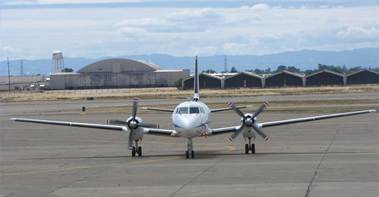
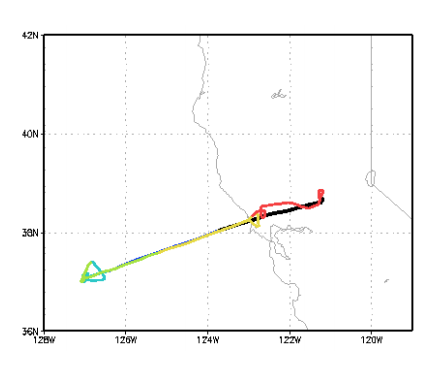
The G-1 aircraft of US Department of Energy (DoE) (upper panel) and its flight plan during ACAPEX. The G-1 flew from Sacramento, California, over the Sierra Nevada to the east and the Pacific Ocean to the west.
An ACAPEX case of layer-cloud with elements of weak
convection was simulated by an earlier version of AC, with validation against
coincident aircraft and ground-based observations, by Waman et al.
(2023). For the present project, we may
choose a different day from this field campaign to simulate. We may try to identify an observed case of
stratiform cloud entirely below the  degC level.
Current progress in
project
The project was funded in late 2021 but started late after some delays in recruitment. A postdoctoral scholar was hired for practical observations at Vindeln and Jungfraujoch. This observational phase was completed successfully, with a publication now almost in press at a prestigious international journal (Paul et al. 2026). Recruitment is underway for the next phase of the work, namely the atmospheric modeling of bioaerosol effects.
Bibliography
Gautam, M., Waman, D., Patade, S., Deshmukh, A., Phillips, V. T. J., Jackowicz-Korczynski, M., Smith, P., and A. Bansemer, 2024: Fragmentation in graupel-snow collisions: new formulation from field observations. J. Atmos. Sci., 81, 2149–2164.
Paul, F. P., Gautam, M., Deshmukh, A., Waman, D., Patade, S., Pichler, C., and M. Jackowicz-Korczynski, 2026: Improved formulation of fragmentation of snow during collisions with graupel/hail based on observations at Jungfraujoch: cold non-dendritic regime of temperature. J. Atmos. Sci., 83, accepted and in review.
Waman, D., Patade, S., Jadav, A., Deshmukh, A., Phillips, V. T. J., Gupta, A. K., and A. Bansemer, 2022: Dependencies of four mechanisms of secondary ice production on cloud top temperature in a continental convective storm. J. Atmos. Sci., 79, 3375–3404.
Waman, D., Deshmukh, A., Jadav, A., Patade, S., Gautam, M., Phillips, V. T. J., Bansemer, A., and J. Jakobsson, 2023: Effects from time dependence of ice nucleus activity for contrasting cloud types. J. Atmos. Sci., 80, 2013–2039.